

New Orleans’ French Quarter has the highest rate of hazard-related review language among major U.S. tourist attractions, while several of the country’s biggest theme parks, including SeaWorld, Walt Disney World Resort and Disneyland Park, also appear among the top 15 in a new analysis of Tripadvisor reviews.
The study, conducted by insurance marketplace PolicyAdvisor, examined reviews of major attractions across the United States and Canada for terms associated with physical hazards, environmental risks, crime, security and bodily harm. Researchers excluded emotional reactions such as visitors saying they felt scared or panicked.
The findings measure the frequency of hazard-related language in visitor reviews rather than verified accident, injury or crime rates. Researchers calculated the number of relevant keyword mentions per 100 Tripadvisor reviews for each attraction.
Niagara Falls Attraction Leads Overall Ranking
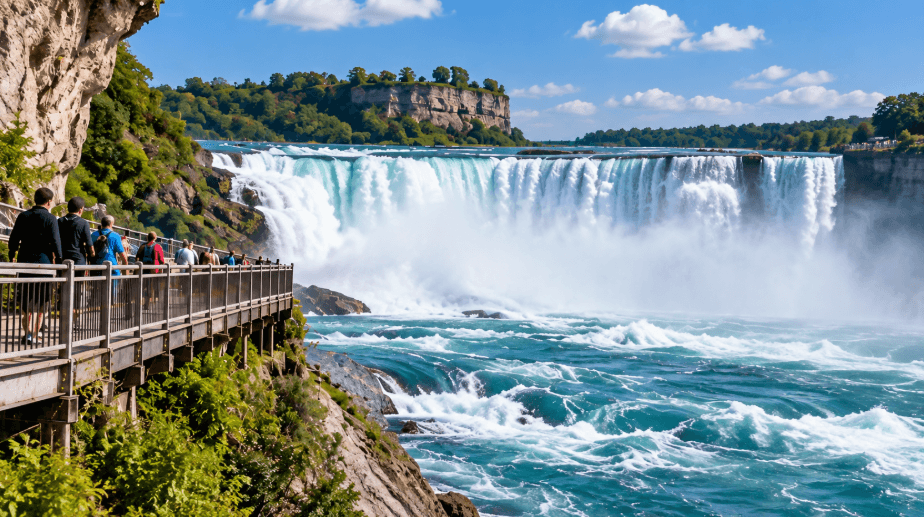
White Water Walk in Niagara Falls, Ontario, ranked first overall, recording 168 hazard-related mentions across 4,393 reviews. That translates to 3.82 mentions per 100 reviews, the highest rate in the study.
“Dangerous” was the most frequently identified term. The attraction is located along the Niagara Gorge, where visitors can observe powerful Class 6 whitewater rapids.
Ripley’s Aquarium of Canada in Toronto placed second with 532 hazard-related mentions among 20,886 reviews, equivalent to 2.55 per 100. Researchers noted that the aquarium operates an exhibit called Dangerous Lagoon, which could account for some appearances of the word “dangerous.”
Whistler Blackcomb ranked third at 2.40 mentions per 100 reviews, followed by Alberta’s Columbia Icefield at 2.05. Both destinations operate in environments where visitors can encounter conditions associated with mountain or glacial terrain.
French Quarter Ranks First Among U.S. Attractions
The French Quarter ranked fifth overall but was the highest U.S. destination in the analysis. Researchers identified 416 hazard-related mentions across 22,912 Tripadvisor reviews, producing a rate of 1.82 per 100 reviews.
Unlike several Canadian outdoor destinations, “unsafe” was the most frequently appearing keyword associated with the French Quarter, indicating that review language was more frequently connected with personal security concerns.
Vancouver’s Gastown followed in sixth place with 1.67 mentions per 100 reviews. The Vancouver Aquarium ranked seventh at 1.55, while Moraine Lake in Alberta placed eighth at 1.50.
The Vancouver Seawall ranked ninth with 1.46 mentions per 100 reviews, where “accident” was the most common keyword. Downtown Vancouver completed the top 10 at 1.37, giving Vancouver four locations among the 10 highest-ranked attractions.
Overall, nine of the top 10 destinations were in Canada.
SeaWorld, Disney Attractions Appear in Top 15
Several major U.S. theme parks appeared just outside the top 10.
SeaWorld in Orlando ranked 11th, with 434 hazard-related keyword mentions among 34,476 reviews, or 1.26 per 100. “Injury” was its most frequently recorded keyword.
Walt Disney World Resort, also in Orlando, tied for 13th with Alberta’s Athabasca Falls at 1.20 mentions per 100 reviews. Disneyland Park in Anaheim, California, followed with 1.07.
Diamond Head State Monument in Honolulu ranked 12th at 1.23 mentions per 100 reviews, while Las Vegas’ Fremont Street Experience placed 15th at 1.06.
Jiten Puri, CEO of PolicyAdvisor, said the findings demonstrate how similar safety terminology can emerge from substantially different visitor experiences.
“The results are interesting because the same safety-related language appears around very different types of attraction. At places such as White Water Walk, Whistler Blackcomb and Columbia Icefield, visitors are dealing with fast-moving water, mountain terrain, ice and changing weather. In the French Quarter or downtown Vancouver, the concerns are more likely to involve personal security and the surrounding area.
“The French Quarter is a good example. ‘Unsafe’ is the most common keyword there, while outdoor attractions more often lead on ‘dangerous’. Elsewhere, terms such as ‘injury’, ‘accident’ and ‘emergency’ feature more heavily, so the context behind the reviews clearly changes from place to place.
“It also highlights why visitors should check they have suitable emergency medical coverage before traveling, particularly when visiting another country. Even a relatively minor injury can become much more complicated and expensive when it happens away from home.
“It is striking how strongly Canada features at the top of the ranking. Nine of the top 10 attractions are Canadian, and Vancouver alone has four entries. A lot of the Canadian names are outdoor or mountain-based attractions, although Gastown and downtown Vancouver show that security concerns also play a part.
“Theme parks remain fairly high in the wider results even once emotional reactions are taken out of the analysis. SeaWorld leads that group, with ‘injury’ appearing most frequently, while Walt Disney World and Disneyland are also among the top 15.
“This is not a measure of verified accident or crime rates, so it would be wrong to say that the attractions at the top are necessarily less safe than those at the bottom. What it shows is where visitors use language connected to physical hazards, injuries, accidents and security most frequently in their reviews.”
The distinction is important: the ranking reflects language used by Tripadvisor reviewers and does not establish that one attraction is objectively more dangerous than another. Instead, it provides a comparison of how frequently visitors mention physical hazards, accidents, injuries and security concerns when describing their experiences.



:quality(85)/cloudfront-us-east-1.images.arcpublishing.com/infobae/45OXD2PP2VAWTFEPJZPEDWSDC4.jpg "The Ortega regime is closing embassies in cities with high immigrant populations, leaving thousands of Nicaraguans homeless.")