


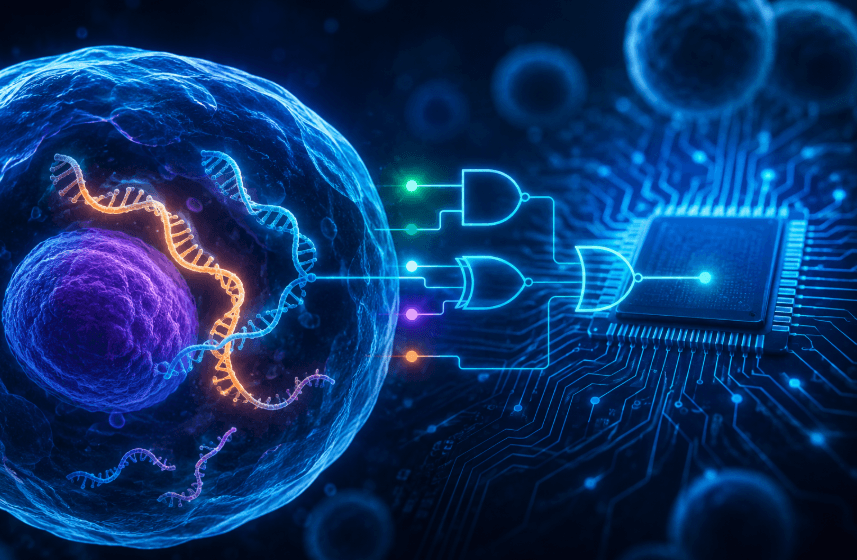
JERUSALEM — Researchers at the Hebrew University of Jerusalem have developed a new method that enables human cells to process information, perform calculations, and make autonomous decisions in a way that resembles the operation of computer processors, a breakthrough that could pave the way for more sophisticated cell-based treatments for diseases such as cancer.
The advancement was detailed in a study published in Nature Communications by Ph.D. student Keren Roas and Dr. Lior Nissim from the Hebrew University of Jerusalem Institute for Medical Research Israel-Canada, Faculty of Medicine. The researchers created artificial genetic systems inside human cells that can process information and execute complex biological instructions, allowing cells to respond more intelligently to their surroundings.
The development addresses a major challenge in synthetic biology, where scientists have long sought to engineer cells capable of detecting disease and automatically responding with therapeutic actions. While the concept has generated significant interest, building complex genetic programs inside living cells has proven difficult because of the limited number of genetic components available to perform increasingly sophisticated functions.
“Our new approach allows cells to carry out complex programs using far fewer calculations and genetic building blocks,” said Dr. Nissim. “This makes it possible to build much more advanced biological programs without losing functionality.”
Building Biological Processors Inside Human Cells
Traditional genetic circuits often become less reliable as they grow more complex. Researchers compare these systems to a multi-story building, where each additional instruction requires another layer of computation. As more layers are added, performance can decline, limiting the complexity of biological programs that can be created.
To overcome this obstacle, the research team turned to a natural biological process known as RNA trans-splicing. This mechanism allows pieces of genetic messages to be joined together within a cell. By combining RNA trans-splicing with both natural and engineered regulatory elements, the scientists created molecular tools that function similarly to biological processors.
The engineered system enables important genetic elements to activate selected genes according to a predefined program. Because multiple signals can be processed simultaneously, the approach requires fewer computational steps than previous genetic circuit designs, improving both efficiency and scalability.
To demonstrate the technology’s capabilities, the team constructed biological devices modeled after components commonly found in electronic computers.
One of these devices was a biological “full adder,” a circuit capable of performing simple binary arithmetic. In digital computing, full adders are essential building blocks within processors and are used to execute calculations. The researchers successfully recreated a comparable function within living cells.
The team also engineered a biological version of a multiplexer, an electronic component that selects one signal from several available inputs and forwards it to the next stage of processing. To observe how these biological circuits operated, researchers used fluorescent proteins that emitted different colors, allowing them to monitor cellular activity in real time.
Safety Features Designed Into the System
Beyond its computational abilities, the new platform incorporates a built-in safety mechanism. When cells detect an invalid or overloaded configuration, they generate a warning signal indicating that an error has occurred within the system.
Researchers believe this feature could become particularly important in future medical applications, where safety and reliability are critical. Such warning signals could potentially trigger protective responses that help prevent unintended cellular behavior during treatment.
The ability to identify and respond to errors mirrors safeguards commonly found in electronic systems and represents an important step toward creating more dependable biological programs.
Potential Applications in Future Medical Treatments
The researchers say the technology could eventually be used to create smart therapeutic cells capable of continuously monitoring their environment and making treatment decisions independently.
For example, a programmed cell could evaluate multiple disease markers simultaneously and release a therapy only when a specific combination of signals is present. Such precision could improve treatment effectiveness while minimizing damage to healthy tissue.
To demonstrate this concept, the team programmed cells to produce Interleukin-15 (IL-15), an immune-system protein known to enhance the activity of cancer-fighting immune cells. The experiment showed how engineered cells could be directed to carry out targeted biological functions based on predefined instructions.
By reducing the amount of genetic material and cellular energy required for decision-making, the new system offers scientists a more efficient and flexible platform for programming living cells.
Researchers believe the approach could help accelerate the development of next-generation precision medicines. As synthetic biology continues to evolve, future therapies may increasingly rely on biological code that instructs cells when to detect disease, how to interpret signals, and when to initiate treatment, bringing the concept of programmable medicine closer to reality.