


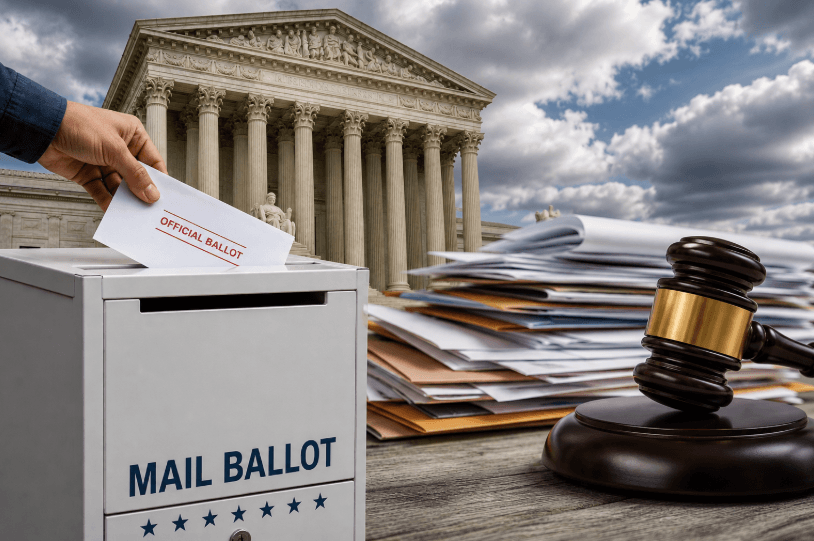
The U.S. Supreme Court’s decision in Watson v. Republican National Committee has reignited debate over election administration in the United States, with the Election Transparency Initiative (ETI) calling on Congress and state legislatures to clarify ballot receipt deadlines if they want Election Day to function as a definitive cutoff for voting.
The ruling centred on whether federal election law requires mailed ballots to be received by Election Day. The Court concluded that existing federal statutes establish when ballots must be cast, but do not require them to be received by Election Day unless such a requirement is imposed by lawmakers.
According to ETI, the decision places responsibility for any future reforms squarely in the hands of elected officials rather than the judiciary.
“From the standpoint of election integrity, requiring all ballots to be received by Election Day remains the gold standard for preventing fraud and strengthening public confidence,” said Ken Cuccinelli, National Chairman of the Election Transparency Initiative. “The Supreme Court did not hold that such a policy would be unconstitutional. It held only that Congress has not enacted that requirement in current federal law. That means lawmakers—not judges—must decide whether to establish a uniform national ballot receipt deadline.”
The Court’s majority opinion, authored by Amy Coney Barrett, acknowledged concerns surrounding election integrity while emphasising the limits of judicial authority in addressing them through statutory interpretation.
Writing for the majority, Barrett stated that “Election fraud and its appearance are serious issues” but concluded that “they must be addressed through the democratic process.” She further explained that if different ballot receipt deadlines warrant a national solution, “the American people must choose it through their elected representatives.”
The opinion underscored that the Court could not add requirements that Congress had not included in federal election law. While recognising ongoing concerns about election administration and public confidence, Barrett indicated that any nationwide standards governing ballot receipt deadlines would need to be enacted through legislation.
The Court also referenced historical precedent, noting that Congress previously established a uniform national Election Day after differing election dates among states generated allegations of fraud and inconsistency. In the Court’s view, if varying ballot receipt deadlines now present a similar concern, lawmakers rather than judges must determine whether a national standard is necessary.
ETI said the decision offers what it described as a clear legislative pathway for policymakers seeking election reforms.
“Justice Barrett’s opinion provides a clear roadmap,” Cuccinelli continued. “Congress solved one election integrity problem by creating a uniform Election Day. If lawmakers believe ballots should be received by Election Day, the Court has made clear that Congress has the authority to enact that policy. Likewise, states remain free to adopt Election Day receipt requirements under their own laws.”
Beyond the question of ballot receipt deadlines, the organisation highlighted another aspect of the ruling that it views as significant. According to ETI, the Court reaffirmed that ballots must be cast by Election Day under federal law, even if individual states permit ballots that were cast on time to arrive after Election Day and still be counted.
Cuccinelli argued that this clarification addresses concerns that some election procedures may create uncertainty among voters regarding when ballots are effectively submitted.
“Unfortunately, some states, like California, have adopted election procedures that can leave the public questioning whether ballots are effectively being cast after Election Day,” Cuccinelli said. “The Court’s opinion makes clear that federal law requires ballots to be cast by Election Day. That clarification is an important safeguard, even as lawmakers continue working to ensure ballots are also received by Election Day.”
ETI said the ruling reinforces a broader constitutional principle concerning the separation of powers. The organisation argued that courts are responsible for interpreting laws as written, while legislatures are responsible for creating and amending those laws to reflect public policy objectives.
As debate over election administration continues across the United States, ETI is urging lawmakers at both federal and state levels to take a more active role in establishing standards that it believes will strengthen public confidence in elections.
“The Court has settled the legal question. Now legislators must settle the policy question,” Cuccinelli concluded. “State lawmakers should stop waiting for courts to solve problems they have the authority to fix. They should require that ballots be received by the close of the polls on Election Day, strengthen chain-of-custody protections for absentee ballots, improve ballot tracking and verification, and eliminate procedures that unnecessarily delay election results or undermine public confidence. Election integrity is achieved through good laws, and this decision makes clear that writing those laws is the responsibility of elected legislators—not judges.”
The decision is expected to fuel ongoing discussions among lawmakers, election officials and advocacy groups over whether additional federal or state legislation is needed to establish uniform ballot receipt requirements ahead of future elections.