

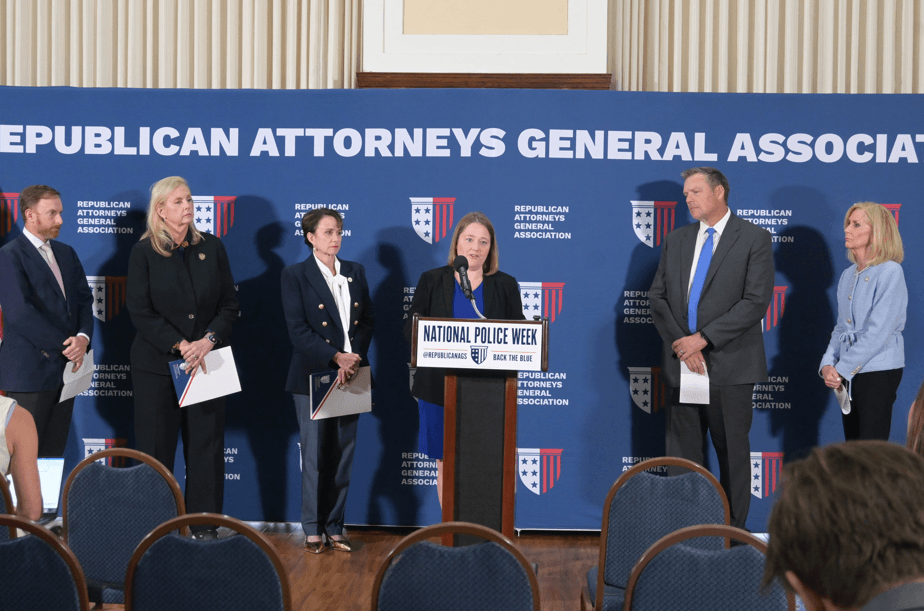
Republican attorneys general from across the United States used National Police Week to highlight their support for law enforcement agencies and outline a series of public safety initiatives aimed at reducing violent crime, tackling drug trafficking and strengthening cooperation between state and local authorities.
Speaking at an event in Washington, D.C., attorneys general from Iowa, Kansas, Mississippi, Missouri, Louisiana and West Virginia pointed to enforcement operations, anti-fentanyl programmes and criminal justice reforms introduced in their respective states over the past two years.
The officials framed public safety as a central political and policy issue ahead of the 2026 election cycle, with several speakers emphasising partnerships between attorneys general offices, police departments and federal agencies.
“When you look at the choice, the choice couldn’t be clearer. We put boots on the ground. We work hard to fight crime,” said Iowa Attorney General Brenna Bird. “It makes a really big difference whether a park is safe for a child to play, what kind of safety your neighborhood has, and whether you’re concerned about being a victim of violent crime.”
Kansas Attorney General Kris Kobach highlighted crime statistics in his state while crediting long-term enforcement efforts and coordination between agencies.
“We now have the lowest crime rate in 56 years. It’s down to 23 index crimes per 1,000 people per year,” said Kansas Attorney General Kris Kobach. “Your chances of being the victim of a crime are very low in Kansas, and it didn’t just happen.”
Several attorneys general also focused on human trafficking investigations and opioid enforcement measures, particularly related to fentanyl distribution.
Mississippi Attorney General Lynn Fitch said multi-agency cooperation had strengthened the state’s ability to combat trafficking networks and support victims.
“We’ve recovered over 400 individuals in our state and helped them go from victims to survivors. We’ve conducted 60-plus multi-jurisdictional operations and arrested nearly 300,” said Mississippi Attorney General Lynn Fitch. “It’s significant work that we do in this office and in all of our offices, because the partnerships we’ve all cultivated with local, state, and federal law enforcement are impactful and powerful. We are certainly all making a difference together.”
Missouri Attorney General Catherine Hanaway said recent crime trends in her state reflected closer cooperation between law enforcement bodies and prosecutors.
“From the White House to Republican Attorneys General offices to state and local law enforcement, we have an unprecedented level of commitment to backing the blue,” said Missouri Attorney General Catherine Hanaway. “For the first time in over a decade, our murder rate in Missouri is way down. 2025 was a 10-year low, and 2026 is trending even better.”
Anti-fentanyl operations and cybercrime investigations expanded
The event also highlighted a range of state-level enforcement initiatives introduced during the past year.
In Iowa, Attorney General Brenna Bird partnered with Governor Kim Reynolds to introduce tougher penalties for fentanyl-related crimes and assaults against police officers. The state also launched a Cold Case Unit that has contributed to multiple arrests and a conviction connected to a decades-old murder investigation.
Mississippi officials reported a reduction in overdose deaths following the expansion of naloxone distribution and fentanyl prevention efforts. Fitch’s office said more than 800 officers had been trained through the state’s Fentanyl Strike Force programme.
Kansas officials highlighted the launch of the Joint Fentanyl Impact Team, which combines resources from the Kansas Bureau of Investigation, Highway Patrol and other agencies to disrupt trafficking networks. Kobach also referenced enforcement actions targeting illegal marijuana and THC products at vape shops and CBD dispensaries in 2025.
Missouri authorities pointed to a crackdown on illegal gaming operations allegedly linked to organised crime and money laundering. According to the attorney general’s office, enforcement measures contributed to the closure of one of the state’s largest illegal gaming machine providers.
Louisiana Attorney General Liz Murrill said her office had strengthened cooperation with law enforcement agencies in New Orleans through an agreement allowing state prosecutors to handle certain criminal cases.
“We put more boots on the ground through the state police, and teamed up with New Orleans Police Department — they make the arrests, my office prosecutes the cases,” said Louisiana Attorney General Liz Murrill. “A criminal doesn’t check your party registration before they carjack you or rob you. We’ve now taken on more than 900 cases pending in New Orleans Criminal District Court. We don’t always agree, but it’s been a highly effective working relationship — and crime in New Orleans is down.”
Murrill also highlighted the expansion of Louisiana’s Internet Crimes Against Children Task Force, which now includes dozens of participating agencies across the state.
West Virginia Attorney General J.B. McCuskey discussed online child safety investigations and support for federal anti-fentanyl legislation. He also warned against criminal justice policies that, in his view, weaken enforcement efforts.
“There are 30 Attorney General seats up for election next year, and so many of them are being filled by George Soros–backed DAs who are for cashless bail,” said West Virginia Attorney General J.B. McCuskey. “They let people out who commit very violent acts.”
RAGA Executive Director Adam Piper said public safety would remain a key political issue nationally.
“There is a clear difference between Republican Attorneys General supporting law enforcement and Democrat Attorneys General supporting cashless bail,” said RAGA Executive Director Adam Piper. “Public Safety is a top issue nationally. Republican Attorneys General have proven results of reducing crime while radical Democrat Attorneys General put criminals first.”