


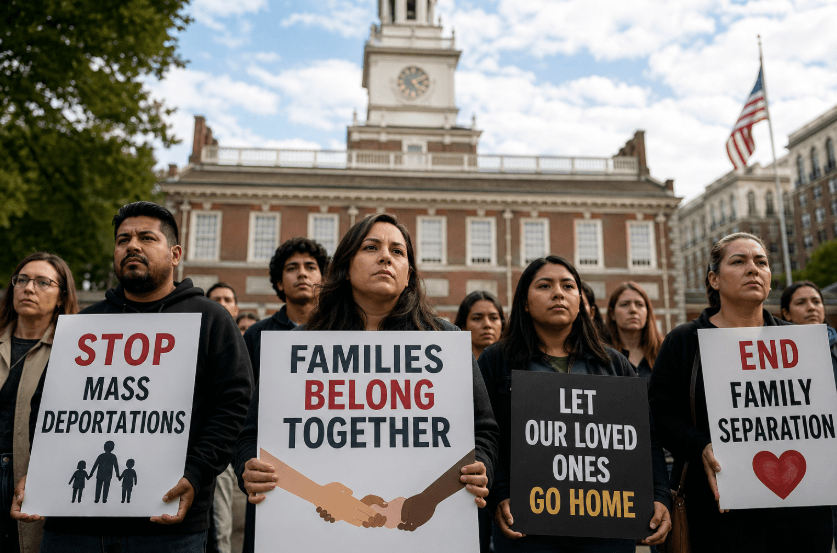
A group of US citizens directly affected by immigration enforcement policies has launched a new nationwide movement aimed at challenging mass deportation and detention practices, citing growing disruption to families, local communities and workforce stability.
The initiative, known as “Connected Americans”, was formally organised during a convening in Philadelphia, where participants from multiple states gathered to share personal experiences and coordinate advocacy efforts. Attendees travelled from across the country, including California, Texas, New York and Washington, D.C., underscoring the broad geographic reach of the issue.
Organisers said the movement seeks to amplify the voices of US citizens living in mixed-status households and to influence public debate and policy direction. The gathering comes as the United States approaches its 250th anniversary, with participants drawing contrasts between current enforcement policies and national ideals around stability and family unity.
According to data cited from the Migration Policy Institute, approximately 14 million people in the US—including citizens, green card holders and visa holders—live with at least one undocumented immigrant. A further 4.2 million undocumented individuals are married to a US citizen or permanent resident, highlighting the scale at which immigration policy intersects with household economics and social cohesion.
Participants described significant personal and financial strain linked to detention and deportation processes, including repeated transfers between facilities, legal uncertainty and workforce disruption.
Angela, a teacher from Pennsylvania, detailed the impact on her family, stating:
“My husband has been moved 16 times, to 11 facilities, over the past eight months – even after we won our case. Every time we think we’re getting closer to bringing him home, he’s moved again. I’m just trying to keep our family together, and it feels like the system keeps pulling us apart. Being here this weekend showed me we’re not alone, and that we can come together, organize, and have a voice.”
Faith leaders and educators also pointed to wider community effects, including reduced school attendance and heightened anxiety among children in affected households.
Josue, a pastor from Texas, said:
“In my church, this is something we’re living through. Families I’ve known for years are now dealing with detention and separation, and some of our own members are in ICE custody. People are scared. They don’t know what’s going to happen next. But this convening showed me the power of coming together, and I hope more people will step forward and join us.”
Nathaly, a teacher from New Jersey, added:
“I see it in my students every day. They are scared, worried about their parents, and living with the constant fear of what could happen to their families. Some do not even know if their mom or dad will be there when they get home. That fear follows them into the classroom, affecting their focus, their attendance, and their ability to be kids fully. I came to the convening because people need to understand the real impact this is having on our communities, and because I want to inspire others to raise their voices, take action, and join this movement.”
Organised advocacy and policy engagement
The Philadelphia event included strategy sessions, media training and coalition-building workshops aimed at strengthening advocacy infrastructure across states. Participants discussed approaches to engage policymakers, increase media visibility and sustain grassroots campaigns.
A roundtable discussion moderated by journalist Paola Ramos brought together individuals directly impacted by enforcement actions to share experiences and outline priorities for reform.
Advocacy leaders said the movement reflects a broader shift from isolated personal accounts to coordinated national action.
“U.S. citizens have had enough, and they’re stepping forward because these policies are affecting their own families and communities,” said Cristina Jiménez, Director of Shared Future. “They’re organizing, building power, and refusing to stay silent as their loved ones face detention and deportation. This is about Americans courageously defending the people they care about and demanding policies that reflect the realities of their lives.”
The campaign is gaining traction as more individuals identify the direct economic and social implications of immigration enforcement on their households.
“What we’re seeing is a growing, organized movement of people who are turning their personal, lived experiences into collective action,” said Greisa Martínez Rosas, Executive Director of United We Dream. “Families are not only speaking out, they’re building the infrastructure to drive change in their communities and across the country.”
As the movement expands, organisers aim to reach a wider audience and influence policy debates, positioning the issue not only as a matter of immigration enforcement but also one of economic stability and community resilience.