


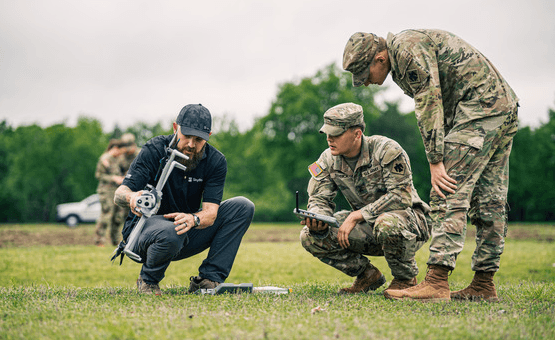
The Oklahoma National Guard and the Oklahoma Office of Emergency Management have concluded a large-scale domestic response exercise designed to test the integration of drone technology into emergency operations, reflecting a broader shift towards data-driven disaster management.
Held at Camp Gruber Training Center on 14–15 April, Exercise Lightning Strike simulated the aftermath of a notional EF5 tornado, bringing together federal, state and local agencies alongside academic and private sector partners. The initiative placed uncrewed aircraft systems (UAS) at the centre of operations, enabling real-time intelligence sharing and improved situational awareness.
The exercise forms part of ongoing efforts to modernise emergency response frameworks, particularly as extreme weather events and infrastructure risks increase demand for coordinated, technology-enabled interventions.
“The primary objective is to improve how agencies work together when using drones and other emerging technologies during emergencies,” said Lt. Col. Franklin Alexander, director of military support for the OKNG. “We’re looking for gaps, friction points, and ways to operate faster and more safely.”
Participants included the Oklahoma Highway Patrol, Muskogee Emergency Management, first responders, as well as national and research institutions such as NASA and the Oklahoma Aerospace Institute for Research and Education. The exercise provided a platform for agencies to operate within a unified command structure, reinforcing interoperability during complex domestic incidents.
“In domestic response missions, the OKNG is never the lead agency,” Alexander said. “In our support role, we take direction from the designated incident command. Training together builds trust, improves communication, and ensures that when Oklahomans need help, agencies operate as one team.”
The two-day programme combined strategic planning with operational deployment. The first day focused on a symposium and a large-scale tabletop exercise, allowing planners and incident commanders to map out coordinated responses. The second day transitioned to live field scenarios, including search and rescue operations, civil disturbance management and wildland firefighting.
“The exercise lanes train on search and rescue, civil disturbance and wildland firefighting, all while integrating uncrewed aircraft systems,” Alexander said. “These scenarios reflect the most common and demanding missions we support across Oklahoma that oftentimes require a multi-agency response.”
From a business and technology perspective, the exercise highlights the expanding role of drone ecosystems in public sector operations. UAS platforms were used to deliver aerial overwatch, stream live footage and support decision-making from remote command posts—capabilities increasingly relevant to both government agencies and private contractors involved in resilience and infrastructure protection.
Effective communication remained a critical factor throughout the exercise. Coordinating airspace between manned and unmanned aircraft, while ensuring alignment across multiple agencies on the ground, required consistent information flow and shared operational language.
“As we go through the exercise and we have a lot of key learnings on how to make that integration work, so that one we’re safe, but also accomplishing that emergency management mission,” said Chris Swan, Oklahoma Aerospace Institute for Research and Education and Air Boss for the exercise “By doing these kind of exercises and really exercising those communication channels and getting common operating language is critical to the effectiveness of the mission.”
Lt. Col. Brent Hill, director of unmanned aerial systems for the Oklahoma National Guard, emphasised the operational value of drones in disaster scenarios, particularly where rapid assessment and response are required.
“These uncrewed aircraft systems can be rapidly deployed to assess damage, locate individuals in distress, and monitor critical infrastructure,” Hill said. “They provide the incident command a real-time snapshot of the current situation.”
The use of live-streaming technology allowed drone feeds to be transmitted directly to offsite command centres, enabling faster, evidence-based decisions. This capability is increasingly seen as a key differentiator in emergency response, reducing delays and improving resource allocation during critical incidents.
Participants also used the exercise to identify capability gaps, particularly in communications, data sharing and inter-agency coordination—areas that remain common challenges in large-scale emergency operations.
“The most common challenges involve communications gaps, information sharing, and understanding each other’s capabilities,” Alexander said. “This exercise allows us to identify and fix those issues in training before they affect a real response.”
Insights gathered from Exercise Lightning Strike are expected to inform future investment and training strategies, particularly around the integration of emerging technologies into domestic response frameworks.
“Success means we tested our command-and-control systems, identified improvements, and left stronger than we arrived,” Alexander said. “More importantly, it means Oklahoma’s emergency response community is better prepared to work together and use new technologies safely to protect lives and critical infrastructure.”