


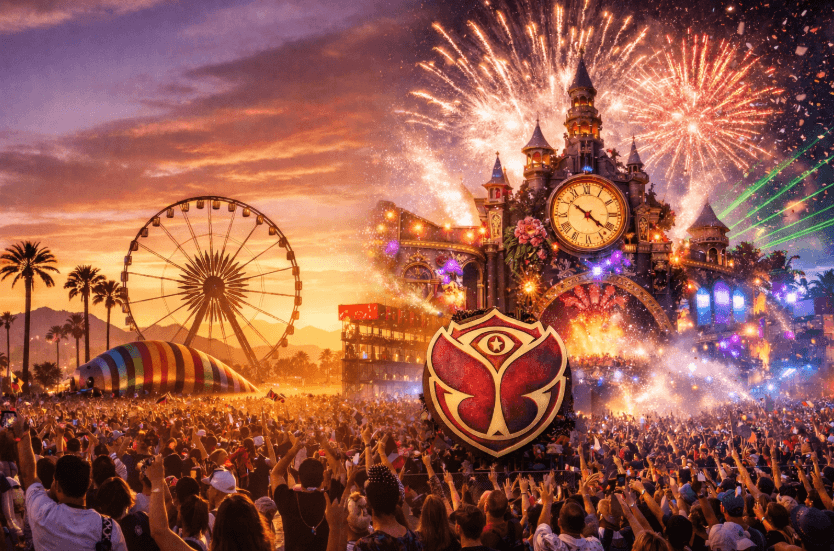
A new global study has ranked Tomorrowland as the most anticipated music festival of 2026, with Coachella securing second place, underlining the continued commercial and cultural dominance of large-scale live events.
The research, conducted by SeatPick, analysed more than 1,000 keyword combinations tied to leading festivals worldwide, including searches such as “Tomorrowland dates” and “Coachella 2026 lineup”. The findings offer a snapshot of consumer intent and digital demand, positioning festivals as key drivers within the global entertainment and travel economy.
Tomorrowland topped the ranking with 2.05 million average monthly searches, narrowly ahead of Coachella, which recorded 1.75 million. Despite ranking second, Coachella remains the most prominent festival in Western markets, outperforming established names such as Glastonbury Festival, Lollapalooza and Burning Man.
Held annually in Boom, Belgium, Tomorrowland has built a global reputation since its launch in 2004, attracting approximately 200,000 attendees each weekend across its two July events. Its large-scale stage production and electronic dance music focus continue to generate significant online engagement.
Coachella, staged in Indio, California, across two consecutive weekends in April, has been a fixture of the global festival circuit since 1999. Drawing around 250,000 attendees each year, it combines major music acts with celebrity appearances and influencer-driven visibility, reinforcing its position as both a cultural and commercial platform.
Established festivals maintain strong global demand
In third place, Lollapalooza generated 1.23 million monthly searches. The Chicago-based, multi-genre festival attracts around 400,000 attendees annually and continues to sell out each year, demonstrating sustained consumer demand.
Glastonbury ranked fourth with more than 800,000 monthly searches, despite 2026 being a scheduled fallow year. The Somerset-based event, held at Worthy Farm since 1970, continues to command global attention even in its absence, reflecting its enduring brand strength and cultural significance.
Burning Man placed fifth with over 636,000 searches. Unlike traditional festivals, the Nevada-based event operates without headline acts, instead relying on participant-created installations and experiences within the temporary Black Rock City.
Further down the ranking, hip-hop festival Rolling Loud secured sixth place, followed by Denmark’s Roskilde Festival, Germany’s Rock am Ring, Tennessee’s Bonnaroo, and Miami’s Ultra Music Festival, completing the top ten.
Digital demand signals wider economic impact
SeatPick’s analysis points to a broader shift in how audiences engage with live events, with search behaviour increasingly acting as a leading indicator of demand.
Gilad Zilberman, CEO of SeatPick, commented: “Music festivals have evolved into some of the biggest cultural events in the world, attracting hundreds of thousands of fans and generating huge online buzz long before the gates even open. Events like Tomorrowland and Coachella don’t just dominate ticket sales, they dominate global search interest, social media and travel trends.
“What really stood out is Glastonbury generating 800,000 monthly searches, and it is not even running this year. That tells you something about how these events have become year-round cultural phenomena, not just weekend parties.
“Large-scale festivals now draw enormous crowds, and these events also have a major economic and cultural impact, with Coachella alone generating over $600 million for the Coachella Valley economy. The global festival market is expected to reach a staggering $20.1 billion by 2027.
“What we’re seeing is that fans aren’t just planning trips, they’re actively searching months in advance to keep up with lineups, rumours, and viral moments. With live streaming, social media content and global fan communities growing every year, the excitement around festivals now extends far beyond the physical crowd on site.”
Festivals evolve into year-round global brands
The data underscores how leading festivals have moved beyond single-event experiences to become year-round global brands, supported by digital ecosystems and international audiences.
For business stakeholders, the findings highlight the growing value of festivals not only as entertainment platforms but as economic engines influencing tourism, hospitality and consumer spending. As anticipation builds months in advance through online engagement, festivals are increasingly shaping global travel patterns and cultural trends.
With demand continuing to rise and digital visibility intensifying, events such as Tomorrowland and Coachella are expected to remain central to the expansion of the global festival market in the years ahead.


:quality(85)/cloudfront-us-east-1.images.arcpublishing.com/infobae/45OXD2PP2VAWTFEPJZPEDWSDC4.jpg "The Ortega regime is closing embassies in cities with high immigrant populations, leaving thousands of Nicaraguans homeless.")