


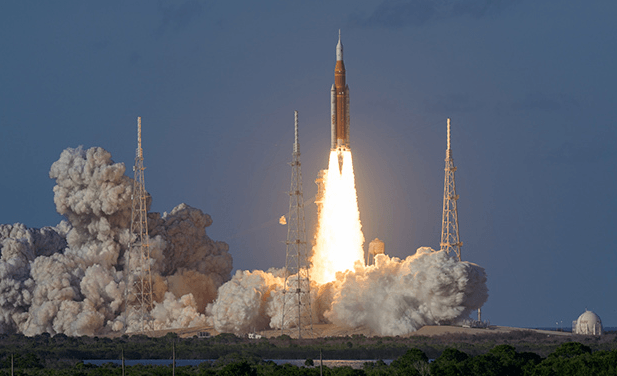
A successful launch of NASA’s Space Launch System (SLS) rocket on 1 April 2026 has marked a significant milestone in the United States’ renewed push towards crewed lunar exploration, with an Oklahoma-based manufacturer playing a central role in the mission’s execution.
The Artemis II mission, which lifted off from Operations and Support Building II at NASA’s Kennedy Space Center in Florida, will carry four astronauts on a 10-day journey around the Moon. It represents the first crewed mission beyond Earth’s orbit in more than half a century and is widely viewed as a critical step towards establishing a sustained human presence on the lunar surface.
Among the key contributors to the mission is Frontier Electronic Systems (FES), a Stillwater-based aerospace engineering firm. The company supplied more than 20 flight-critical components used in both the Orion crew capsule and the SLS rocket, underlining the importance of regional supply chains in major space programmes.
State officials have been quick to highlight the contribution as evidence of Oklahoma’s growing role in the global aerospace sector. The Oklahoma Department of Aerospace and Aeronautics (ODAA) and the Oklahoma Space Industry Development Authority (OSIDA) jointly emphasised the strategic importance of the company’s involvement.
“Oklahoma has always been a pioneer in flight and space exploration,” said Grayson Ardies, OSIDA CEO. “Today, FES proves our state’s aerospace industry is more than just a heritage; it is a critical engine for NASA’s return to the Moon. From critical flight controls to life-supporting electronics, Oklahoma’s contributions are integral to this mission.”
Frontier Electronic Systems’ work spans several mission-critical systems that directly support astronaut operations and spacecraft performance. Among its most prominent contributions are the rotational and translational hand controllers used by astronauts to pilot the Orion spacecraft during flight. These precision devices are essential for manoeuvring and control during the mission.
In addition, the company developed cockpit interface tools, including cursor control devices and switch interface panels. These systems enable astronauts to interact with onboard data, issue commands, and monitor spacecraft systems in real time, forming a vital link between human operators and advanced onboard technology.
FES also contributed to safety and propulsion systems, supplying electronic control boards for the Launch Abort System (LAS), located at the top of the rocket, as well as thruster electronics positioned at the base of the SLS core stage. These components are designed to ensure both mission safety and performance reliability under extreme conditions.
The Artemis II mission itself is intended to validate critical systems required for future lunar landings. By demonstrating crew safety, navigation capabilities, and overall mission readiness, NASA aims to lay the groundwork for subsequent missions that will return humans to the Moon’s surface for the first time since the Apollo era.
Beyond the immediate mission, the launch coincides with a period of accelerated growth in Oklahoma’s space and aerospace sector. A recent organisational merger between the Oklahoma Space Industry Development Agency and ODAA has been positioned as a strategic move to streamline efforts and prioritise space industry expansion within the state.
Particular attention is being given to the Oklahoma Air and Space Port in western Oklahoma, which is being developed as a national hub for horizontal launches and microgravity research. State officials believe such infrastructure will attract both domestic and international investment as commercial space activity increases.
Further strengthening this outlook are partnerships with private-sector companies such as Dawn Aerospace. The firm has announced plans to operate its Mk-II Aurora spaceplane from Oklahoma by 2027, signalling confidence in the state’s long-term viability as a base for advanced aerospace operations.
Taken together, these developments point to a broader shift in the geography of the space industry, with regional manufacturing hubs and emerging spaceports playing an increasingly prominent role alongside established federal facilities.
For Frontier Electronic Systems, participation in Artemis II not only reinforces its technical capabilities but also positions the company within a growing network of suppliers supporting next-generation space exploration.
As the Artemis programme progresses, the success of missions like Artemis II will likely depend as much on these distributed industrial contributions as on the headline achievements of launch and exploration—highlighting the interconnected nature of modern aerospace innovation.



:quality(85)/cloudfront-us-east-1.images.arcpublishing.com/infobae/45OXD2PP2VAWTFEPJZPEDWSDC4.jpg "The Ortega regime is closing embassies in cities with high immigrant populations, leaving thousands of Nicaraguans homeless.")