

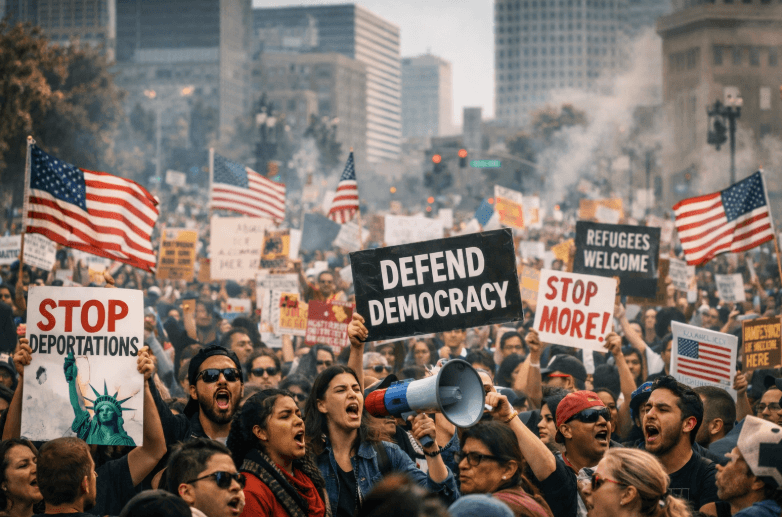
Large-scale demonstrations across major US cities are intensifying scrutiny of immigration enforcement practices and the broader direction of federal authority under President Donald Trump, as campaigners argue that sustained public mobilisation is essential to protecting democratic norms.
The latest wave of protests follows a highly contentious immigration enforcement incident in Minneapolis that has fuelled national outrage and renewed calls for transparency, accountability and limits on the use of force. Organisers and participants say the unrest reflects not only grief, but deepening fear and insecurity among communities affected by federal immigration operations.
While details surrounding the Minneapolis case remain disputed in public discussion, the scale and spread of demonstrations suggest a wider crisis of confidence in how enforcement powers are exercised. Observers note that the protests have moved rapidly beyond a single event, reflecting long-standing tensions between federal agencies and segments of the public.
Campaigners argue that peaceful protest remains a central democratic mechanism for holding institutions to account, particularly when other avenues are seen as ineffective. They say the ability of citizens to assemble, speak freely and challenge government policy is fundamental to democratic resilience.
“The people in American cities protesting ICE are doing what must be done, albeit at great risk. But there is no substitute for people actually pouring into the streets and peacefully protesting,” the statement said. “Public protest is not symbolic or abstract; it is a concrete action that matters greatly, as it makes it much more difficult for the government to commit crimes with no accountability.”
The protests have been reported in cities with sharply different political profiles, from traditionally liberal urban centres to more conservative regions, with demonstrators voicing broadly similar concerns. These include the perceived erosion of public trust, the role of federal agencies in local communities, and the consequences of aggressive enforcement strategies.
The statement also frames the demonstrations as part of a wider effort to defend democratic principles. It argues that peaceful mass mobilisation can send a strong message to political leaders without escalating into violence, and that sustained civic engagement is required to prevent further deterioration in public confidence.
“When a government violates democratic principles, large-scale peaceful demonstrations can send a strong message. It’s a way for people to collectively demonstrate their commitment to democratic values and advocate for change without resorting to violence,” the statement said.
From a business and policy standpoint, analysts note that prolonged unrest can have knock-on effects for local economies, transport networks and commercial activity, particularly in city centres where demonstrations are concentrated. Retailers, employers and public service operators may face disruption, while heightened political tension can weigh on consumer sentiment and investor confidence.
However, supporters of the protests argue that short-term disruption must be weighed against longer-term concerns about governance, public consent and institutional legitimacy. The statement describes what it sees as a growing imbalance between enforcement authority and accountability mechanisms, warning that the erosion of trust can create wider instability.
“The demonstrations arose from the struggle to reconcile enforcement power with public trust, which has dramatically eroded,” it said. “The public reaction echoes profound concerns about how immigration enforcement is conducted, how federal authority is exercised, and how accountability was absent when lethal force was used by federal agents.”
The author also contends that ongoing demonstrations should remain peaceful, but can include other forms of lawful civic pressure such as strikes and civil disobedience. It argues that broad participation across political, ethnic and religious lines is necessary to sustain momentum and reinforce a shared commitment to constitutional principles.
Continued, relentless, and frequent peaceful demonstrations by the millions from coast to coast are sine qua non for protecting our democracy and bringing an end to the nightmare that has engulfed the country. Millions of Americans, irrespective of their political orientation, race, ethnicity, or religion, who care about the country’s future, must pour into the streets, with one message:
We will never be deterred, succumb or be intimidated, and we will remain resilient and steadfast and resort to any other peaceful means, including civil disobedience and strikes, until Trump halts his violations of our democratic principles and fully adheres to his oath of office to defend and protect the Constitution.
Alongside street demonstrations, the statement urges the expansion of community-level engagement through town halls, civic forums and local dialogue, describing open debate as another form of democratic participation. It argues that educators, civil society organisations and community leaders can play a role in reducing polarisation and strengthening civic cohesion.
“Expressing dissent, however, is not limited to peaceful protests; fostering open dialogue is another way for people to express dissent, and it can involve different groups,” the statement said. “Saving our democracy is a shared duty and responsibility across society.”
The statement concludes by arguing that the public should be prepared to defend democratic values through sustained civic action, warning that the consequences of political disengagement could be severe. While its language is sharply critical of the administration, it centres on calls for peaceful mobilisation and adherence to constitutional norms.
“It cannot be reiterated enough that relentless and massive public protest from coast to coast is the only way to stop this lawless Trump administration from destroying our democracy before it’s too late…..”