


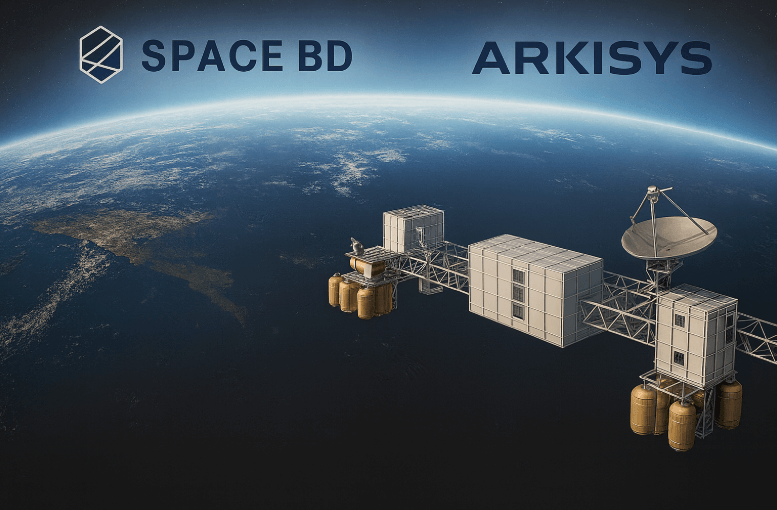
Space BD Inc. has signed a new memorandum of understanding with US-based Arkisys, Inc. in a move set to accelerate the development of next-generation commercial space infrastructure. The agreement, announced on 3 December in Tokyo, positions both companies to play a central role in the emerging market for in-orbit servicing, assembly and long-term space logistics platforms.
Development of Arkisys’ Port Module Takes Centre Stage
The Japanese space services provider, known for its work in satellite launch brokerage and access to the International Space Station (ISS), will support Arkisys in conducting on-orbit demonstrations of its modular Port Module technology. The Port Module forms the backbone of Arkisys’ planned Port Architecture in Space — an in-space platform designed to host, service, integrate and upgrade customer payloads throughout their operational life.
The partnership marks a significant development in efforts to create infrastructure capable of enabling sustainable commercial operations in low Earth orbit and beyond. Each Port Module is engineered as a multi-purpose orbital node, providing facilities for technology demonstrations, payload servicing and extended infrastructure support.
Space BD to Supply ISS Access and Integration Services
To support the initiative, Space BD will provide access to its i-SEEP (IVA-replaceable Small Exposed Experiment Platform) service, installed on the exterior of the ISS’s Japanese Experiment Module, “Kibo.” The service allows hardware to be mounted externally for exposure to the space environment. Space BD will also handle engineering, payload integration and coordination with JAXA and NASA. This includes launch logistics and procurement of components required to deploy Arkisys’ payload.
Robotics Demonstrations Build on Arkisys’ Work With NASA
Arkisys intends to use the collaboration to validate technologies central to its long-term strategy, including robotic servicing systems. The company is already working with NASA through the Astrobee free-flying robotic platform aboard the ISS. By using Astrobee, Arkisys aims to refine robotic manipulation, docking and client-interface technologies expected to play an essential role in future Port-based operations and other servicing missions.
Industry Leaders See Strategic Value in In-Orbit Servicing
Chief executive Dave Barnhart emphasised the long-term ambitions behind the partnership, stating:
“This agreement marks a major step forward in our shared vision of enabling a globally sustainable and modular orbital economy. By demonstrating core elements of The Port architecture in orbit with Space BD’s support, we are laying the foundation for a growth based space economy that incorporates autonomous servicing and logistics for a wide range of commercial, academic, and government markets.”
Industry momentum has increasingly shifted toward in-orbit servicing, modularity and reconfigurable platforms as satellite fleets expand and mission lifetimes grow. Such technologies are seen as vital for reducing operational costs and enabling more complex missions.
A Strategic Alignment With Global Commercial Space Trends
For Space BD, the collaboration strengthens its role as a key facilitator of international commercial activity on the ISS, particularly via JAXA’s Kibo module. For Arkisys, the agreement provides an opportunity to demonstrate critical components of its Port Module in orbit, a major step toward establishing autonomous commercial ports capable of supporting long-term infrastructure in space.
The memorandum of understanding highlights the accelerating shift away from static satellite systems toward dynamic platforms designed for servicing, upgrading and mission reconfiguration. As governments and industry expand their ambitions in orbit, technologies such as Arkisys’ Port Module are expected to play a central role in shaping the future orbital economy.