

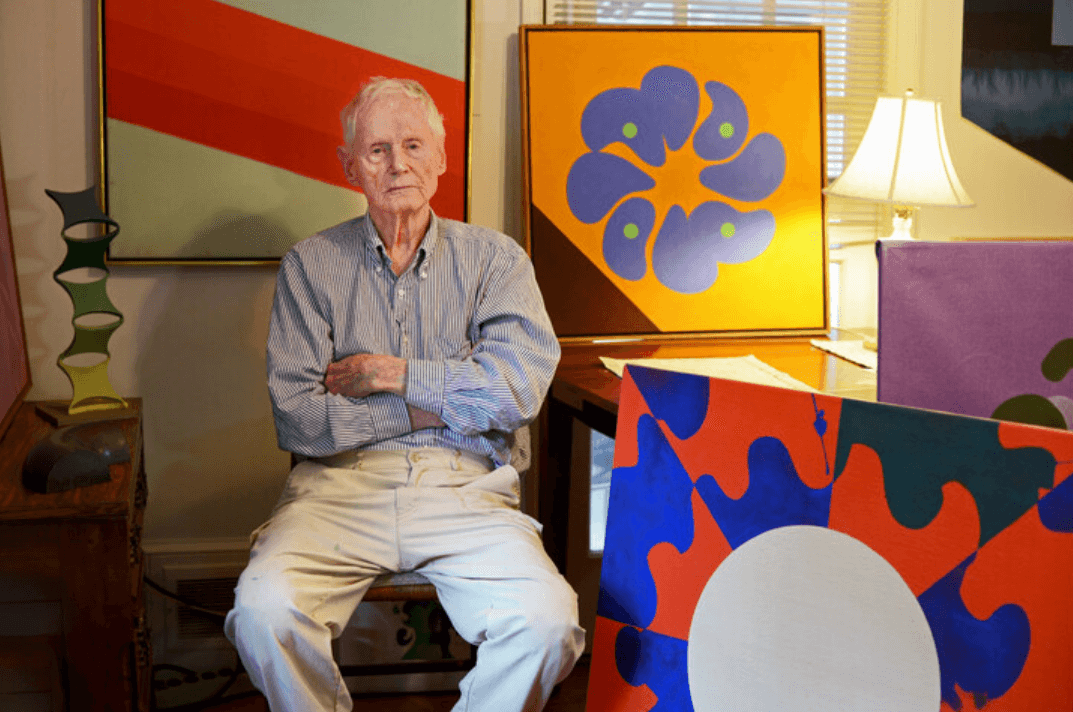
The Oklahoma City Museum of Art (OKCMOA) is set to open a landmark exhibition this weekend, marking the first major retrospective dedicated to the American abstract artist Paul Reed. Scheduled to open on Saturday, 22 November, the exhibition aims to reposition Reed’s legacy within the broader narrative of postwar American art and the Washington Color School movement, where his contributions have often been overshadowed.
Announced on Thursday, the museum confirmed that Paul Reed: A Retrospective will serve as the most comprehensive presentation of Reed’s work to date. Guest curated by David Gariff, PhD, a senior lecturer at the National Gallery of Art, the show spans more than six decades of artistic development and experimentation.
“As the definitive home of Paul Reed’s work, we’re proud to be opening this first major retrospective,” said OKCMOA President and CEO Michael Anderson, PhD. “As we celebrate Reed’s commitment to his practice and his impact on the postwar landscape of American art, we invite visitors to learn more about an artist who has largely been overlooked in the Washington Color School narrative.”
A Chronological Exploration of Reed’s Artistic Evolution
The exhibition will occupy more than half of the museum’s third floor, offering visitors a chronological journey through Reed’s evolving style and technical innovation. The opening galleries will present Reed’s early output, including a 1938 self-portrait and a series of still-life works created in the stylistic traditions of Paul Cézanne and Pablo Picasso. These formative pieces underscore the classical training and influences that shaped Reed’s early artistic identity before his transition to abstraction.
As the exhibition progresses, audiences will encounter Reed’s distinctive visual language emerging in series such as Upstart and Mandala. These works highlight his move toward bold colour fields, dynamic geometric structures and a growing interest in the expressive possibilities of new materials and methods. The museum notes that Reed’s work from this period demonstrates a confident shift towards the individual style that would come to define his place within American abstraction.
Large-Scale Works and Technical Experimentation
Mid-career works illustrate Reed’s experimentation with large-scale forms, including several shaped canvases—one reaching an impressive fourteen feet in height. The section also explores Reed’s engagement with sculpture and his creative expansion into screenprinting during the 1970s, which further broadened the artist’s technical repertoire.
Late Career Works and Continued Innovation
The final portion of the exhibition focuses on Reed’s later years, tracing his practice from pieces produced in his spacious studio to smaller-scale works completed in his Arlington, Virginia home. These include gouache paintings on paper, photo collages and intimate canvases that continue to explore themes established earlier in his career. Despite their reduced scale, these works retain the artist’s characteristic vibrancy, formal precision and commitment to experimentation. Among the techniques highlighted is Reed’s early adoption of Magna acrylic paint, which he applied through staining raw canvas—a method that became a hallmark of the Washington Color School.
Contextual Installation on the Washington Color School
Upon exiting the retrospective, visitors will enter The Legacy of the Washington Color School, a contextual installation that examines the movement’s long-term influence. The gallery presents works by both first- and second-generation artists, including Mokha Laget, a former student of Reed from his teaching tenure at the Corcoran College of Art and Design. The museum states that this concluding installation is designed to frame Reed’s career within the broader cultural and artistic dynamics of the period.
Programming and Exhibition Details
Alongside the exhibition, OKCMOA has organised an extensive schedule of related programming, offering classes, guided tours and Drop-In Art sessions. Museum officials expect strong demand for these events, advising early registration. Full details are available on the institution’s website.
Paul Reed: A Retrospective will remain open until 12 April 2026. Museum members will receive free access to the exhibition as well as discounted rates for associated programmes. Further information on membership and benefits can be found at okcmoa.com.