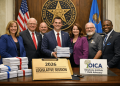










OKLAHOMA CITY — Oklahoma lawmakers have closed the final pre-session filing window for the 2026 legislative year, setting the stage for what is expected to be a wide-ranging agenda when the state’s Second Regular Session of the 60th Legislature begins early next month.
The completion of bill filing in both the Oklahoma House of Representatives and the Oklahoma State Senate marks the last major administrative milestone before formal debates and committee work begin at the Capitol.
Over the past several weeks, legislators and staff have worked to draft proposals that could shape policy priorities for the year ahead, spanning public services, government operations and budgetary decisions. The session will commence on Monday, February 2 at noon with Governor Kevin Stitt’s State of the State address as he begins the final year of his second term in office.
Bill filings surge as lawmakers prepare for February start
The legislative bodies completed bill filing Thursday, January 15. A total of 1,578 House bills and 50 House joint resolutions were filed before the deadline. Likewise, a total of 996 Senate bills were filed for 2026, with 23 Senate joint resolutions and two Senate concurrent resolutions.
In addition to the new submissions, a significant volume of measures from the previous year remains active under legislative rules. This flurry of bills joins more than 1,600 House measures and more than 900 Senate bills and resolutions carried over from 2025 which remain eligible for consideration in the 2026 legislative session.
The scale of the legislative pipeline is likely to increase the workload for committee chairs, legislative analysts and advocacy groups as they assess which proposals could advance quickly and which may be held over for later debate.
Among those reviewing the filing list is the Oklahoma Institute for Child Advocacy (OICA), which said it is examining the measures with a focus on how they may affect young people and families across the state.
The Oklahoma Institute for Child Advocacy (OICA) team is combing through these bills to see which, in their initial stages, will be pro-child. Over the next few weeks, we will be sharing with you which among all these measures are good for children in Oklahoma and those which might cause harm.
Political balance set as OICA promotes advocacy training
The new session will take place with Republican majorities in both chambers. The House of Representatives is currently comprised of 80 Republicans and 19 Democrats with two vacancies. The Senate currently has a membership of 40 Republicans and 8 Democrats. Lt. Gov. Matt Pinnell, who serves as the President of the Senate, is also in his final year under the two-term limit to hold an executive office.
With the legislative calendar now fixed, OICA is also encouraging members of the public, particularly those in the nonprofit sector, to deepen their understanding of the policymaking process.
With this, if you are a casual observer of Oklahoma politics and the legislative process, but you might want to learn more so you can engage in policymaking as an advocate, I have a great recommendation for you.
For years, OICA held a conference to help educate about the nuances of the lawmaking process called the Legislative Learning Lab (LLL). In 2025, the decision was made to turn this program over to the Oklahoma Center for Nonprofits (OKCNP) to hopefully broaden the scope of this training to reach more interested individuals.
This year, LLL will be held both in-person and virtually for attendees to participate and learn best practices of the legislative process. The two-day training will be held on Thursday, January 29 and Friday, January 30 at the OKCNP headquarters located at 701 N. Lindsay in Oklahoma City from 9 a.m. to 4 p.m. The link to register for this training is https://okcnp.org/events/EventDetails.aspx?id=1980898&group=. For those attending in person or virtually, instructions will be sent upon registration.
The training programme is expected to cover a range of topics that are relevant to organisations seeking to engage with state government, including funding priorities, communications strategies and the regulatory environment.
Across the two days, topics include: conversations with state legislative leaders; understanding the state budget and its impact; working with government agencies and lobbyists; building coalitions and grassroots advocacy campaigns and discussing key issues for nonprofits, including the Johnson Amendment; and the upcoming 2030 Census, along with other relevant and timely topics.
The speaker list includes elected officials, academic experts and professionals who work in and around the state capitol, offering participants a broad view of how legislation is developed and debated.
We will hear from such speakers as Sen. Chuck Hall, the Senate Appropriations and Budget Committee chair about Oklahoma’s budgetary process; Dr. Keith Gaddie will present about Oklahoma’s political history and how we got to where we are; Reps. Emily Gise, R-Oklahoma City, and Andy Fugate, D-Del City, will discuss caucus priorities for their respective caucuses; panels of Capitol reporters and lobbyists will discuss how their work functions during the legislative session; and, I will present an overview of the three branches of government and how they work as a dynamic to create laws.
Attendance is priced differently depending on membership status and whether participants attend online or in person, with organisers positioning the programme as a practical introduction for those looking to follow policy developments more closely.
The cost to attend in-person is: OKCNP members $150, non-members $300; and virtually online OKCNP members $100 and non-members $200. I hope that you will be able to join us for this program which will certainly benefit those who want to help in the policymaking process.
With hundreds of proposals now filed and more carried over from last year, attention will turn to committee assignments and early session priorities as Oklahoma’s lawmakers begin formal deliberations in February.