
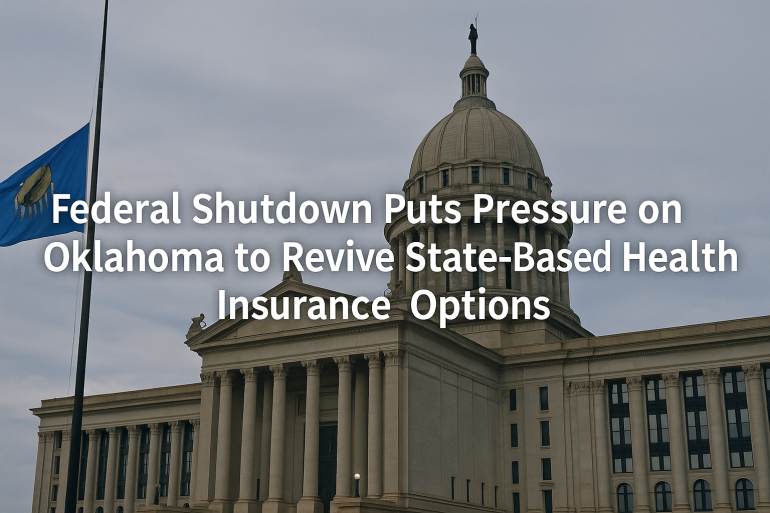
As the federal government shutdown continues to ripple through public services, concerns are mounting that subsidies provided under the Affordable Care Act (ACA), commonly known as Obamacare, could soon be reduced or eliminated. Such a move would place renewed responsibility on individual states to secure affordable health coverage for their residents.
In Oklahoma, policymakers and employers are revisiting a long-established state initiative that could help sustain coverage for thousands of working citizens should federal support be withdrawn.
A State Solution for Health Coverage
Introduced in April 2004 under Senate Bill 1546, authored by Senator Ben Robinson and Representative M.C. Leist, the legislation authorised the Oklahoma Health Care Authority (OHCA) to develop a dual-option health insurance programme. Known as Insure Oklahoma, it assists small business employees aged between 19 and 64 through either a subsidy toward private health plan premiums — known as Employer Sponsored Insurance (ESI) — or through the purchase of a state-sponsored health plan operated under the state’s Medicaid programme, referred to as the Individual Plan.
The initiative set out an ambitious goal: to provide affordable health insurance to 50,000 low-wage Oklahomans employed across the state’s small business sector.
The OHCA remains the administering body, balancing financial responsibility with two key objectives:
-
“Assuring that state-purchased health care meets acceptable standards of care,” and
-
“Ensuring that citizens of Oklahoma who rely on state-purchased health care are served positively.”
Insure Oklahoma’s Renewed Relevance
While the ACA’s implementation initially made Insure Oklahoma redundant, a rollback of federal provisions could restore its relevance. The programme offers a ready-made mechanism for maintaining healthcare access among working adults without imposing new fiscal burdens on the federal government.
For employers, participation requirements are clearly defined. Businesses must be located in Oklahoma, offer a qualified benefit plan, and contribute at least 25 per cent toward employee premiums. For-profit employers may have up to 250 employees, while non-profit organisations may employ up to 500 workers.
Eligible employees must be Oklahoma residents aged 19 to 64, meet citizenship requirements, and earn within income limits established for the ESI scheme. Participants must not be enrolled in Medicare or SoonerCare (Medicaid) and are expected to contribute up to 15 per cent of their own premium costs — not exceeding three per cent of their annual gross household income.
Political Collaboration and Expansion
Although Insure Oklahoma was created under Democratic leadership, Republican lawmakers later recognised its value in supporting a healthy, productive workforce and enacted several amendments to broaden access.
In 2007, the programme was extended to include self-employed individuals, certain unemployed residents, and workers without access to group health coverage. Two years later, eligibility widened again to cover full-time college students aged 19 to 22 within qualifying income limits.
Further adjustments raised the ESI business size limit to 99 employees initially, later expanded to 250, and extended eligibility to non-profit organisations employing more than 250 workers. Coverage was also expanded for dependent children of members earning between 186 and 200 per cent of the federal poverty level. Additionally, digital submission of applications was introduced to improve accessibility and administrative efficiency.
Income Thresholds and Future Considerations
Despite its benefits, Insure Oklahoma faces challenges in adapting to current economic realities. Present income thresholds mean a single applicant must earn no more than $35,700 annually to qualify. The limits increase to $48,228 for a household of two, $60,756 for three, $73,320 for four, and $85,848 for a family of five.
Advocates argue that these income caps no longer reflect modern wage and cost-of-living standards, and that lawmakers will need to revisit the payroll thresholds to ensure continued coverage for working residents.
A Call for Action
As uncertainty persists over federal healthcare funding, state officials and business leaders are being urged to explore sustainable solutions.
“I encourage our state leaders to look at this program or similar opportunities to do whatever is possible to help keep employed Oklahomans healthy and thriving,” the release concludes. “A healthier workforce means stability, productivity and allows parents to not deal with astronomical healthcare costs.”
The current political climate has placed renewed emphasis on state-level innovation, and for Oklahoma, Insure Oklahoma stands as both a legacy of bipartisan collaboration and a potential blueprint for future healthcare resilience.



:quality(85)/cloudfront-us-east-1.images.arcpublishing.com/infobae/DKFF3WSAVNFJ5KOC2PZGQHGU4I.jpg "Scarlett Johansson says she was forced to hire legal counsel to deal with Sam Altman and OpenAI")