

A major solar storm is expected to reach Earth within the next day, with forecasters warning of possible geomagnetic disturbances that could briefly affect communications, navigation systems and power infrastructure. The event, driven by a recent burst of solar activity, could also produce spectacular auroral displays visible far beyond their usual latitudes.
Global Alerts from BOM and NOAA
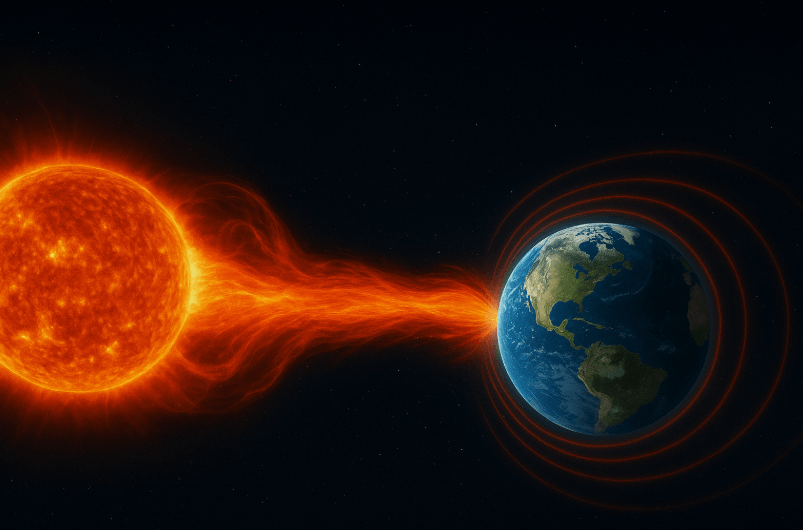
The Australian Bureau of Meteorology (BOM) and the US National Oceanic and Atmosphere Administration (NOAA) have both issued alerts following a series of “coronal mass ejection” (CME) events from the Sun over the past 48 hours. These ejections — vast clouds of charged particles propelled from the Sun’s surface — are travelling through space and expected to interact with Earth’s magnetic field, triggering what scientists refer to as a geomagnetic storm.
The agencies’ forecasts indicate that the storm’s intensity could be strong enough to generate visible auroras across large areas of the southern hemisphere. The BOM’s Australian Space Weather Forecasting Centre reported that “visible auroras are possible in mid-to-southern parts of Australia”, perhaps as high as Sydney or Perth. Such displays, normally confined to polar regions, occur when high-energy particles collide with gases in the upper atmosphere, causing them to glow in shifting shades of green, red and purple.
Expert Commentary from the University of Sydney
While the event has prompted widespread interest among skywatchers, experts have emphasised that the overall likelihood of serious disruption remains low. Nonetheless, heightened solar activity can interfere with high-frequency radio communication, satellite signals and global positioning systems (GPS) — systems relied upon by industries from aviation and shipping to telecommunications and defence.
Astronomer Dr Laura Driessen, from the Sydney Institute for Astronomy and the School of Physics at the University of Sydney, is available to comment on the storm and its possible effects. See her post about this on Instagram at this link.
Dr Driessen, who studies the interaction between solar and planetary magnetic fields, said she can discuss “how high geomagnetic output from the Sun can trigger visible auroras,” as well as “how solar storms can impact high-frequency radio infrastructure or GPS,” and “the likelihood of disruption (which is low).”
Potential Impact on Business and Infrastructure
Her remarks underline the delicate balance between natural space phenomena and the growing dependence of global economies on satellite-based technology. For businesses operating in sectors sensitive to signal disruption — such as finance, logistics and communications — even short interruptions to timing systems or navigation services can have cascading effects.
According to NOAA, geomagnetic storms are graded on a scale from G1 (minor) to G5 (extreme). While this week’s event is not expected to reach the higher end of that spectrum, it serves as a reminder of how space weather — often overlooked outside scientific circles — can have tangible impacts on modern infrastructure.
Monitoring and UK Preparedness
In the UK, the Met Office Space Weather Operations Centre (MOSWOC) is monitoring the event closely. Britain’s power and telecommunications networks have built-in safeguards to mitigate solar interference, but operators remain alert during such periods. Previous storms of similar strength have occasionally disrupted radio transmissions, affected GPS accuracy, and caused minor power fluctuations at high latitudes.
Aurora enthusiasts in northern parts of the UK — including Scotland, Northern Ireland and northern England — may also have an opportunity to witness enhanced night-sky activity if geomagnetic conditions align. Observers are advised to seek dark, open areas away from city lights for the best view.
Solar Cycle and Future Outlook
As the Sun approaches the peak of its current 11-year solar cycle, forecasters expect such events to become more frequent. Increased solar output typically brings both scientific opportunities and operational challenges, prompting renewed interest in global space-weather preparedness.
For now, agencies stress that the situation remains under control. The storm’s passage is being tracked in real time, and further updates will be issued by space weather forecasting centres as new data become available.