


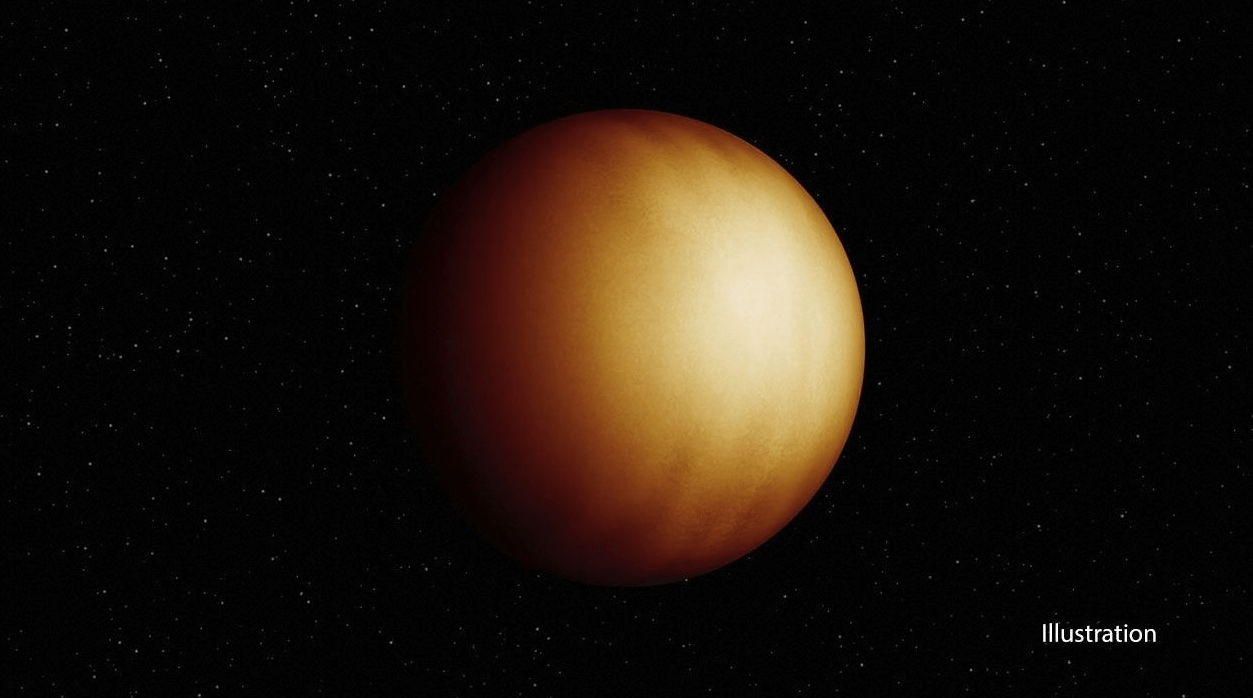
Astronomers have produced the first-ever three-dimensional map of a planet outside our solar system, revealing extreme temperature differences across its atmosphere — including a zone so hot it breaks down water vapour.
The groundbreaking study, published on 28 October in Nature Astronomy, charts the temperature layers of WASP-18b, a gas giant about 400 light years from Earth. Known as an “ultra-hot Jupiter,” the planet orbits perilously close to its host star, completing a full revolution in less than 24 hours.
Researchers say the findings mark a step-change in the way scientists can observe and understand exoplanet atmospheres. The work pioneers a technique called three-dimensional (3D) eclipse mapping, or spectroscopic eclipse mapping, which allows astronomers to model a planet’s temperature structure in unprecedented detail.
The international research team, which includes Dr Anjali Piette of the University of Birmingham, developed the new 3D model by expanding upon a two-dimensional (2D) version they published last year. That earlier effort demonstrated the potential of eclipse mapping using highly sensitive observations captured by NASA’s James Webb Space Telescope (JWST).
Publishing their findings in Nature Astronomy, researchers say that, for many similar types of exoplanets observable by JWST, they can now begin mapping atmospheric variations – just as Earth-based telescopes long ago observed, for example, Jupiter’s Great Red Spot and banded cloud structure.
Co-author Dr Anjali Piette said:
“It’s really exciting to be able to see an exoplanet in 3D. Most exoplanets are so close to their bright host stars that we can’t take images of them like the solar system planets – but spectroscopic mapping gives us a new window into their 3D structures.”
Mapping the Unseen
Detecting exoplanets in the first place is notoriously difficult. They typically emit less than one percent of the light of their parent stars. Eclipse mapping relies on detecting minute changes in light as a planet passes behind its star, temporarily blocking and revealing different parts of its illuminated surface.
By analysing these fractional changes across multiple wavelengths of light, scientists can produce brightness maps. When interpreted across colours corresponding to different temperatures and altitudes, these data yield a full three-dimensional view of a planet’s atmosphere — showing latitude, longitude and altitude.
Lead author Ryan Challener, a postdoctoral associate at Cornell University, explained the complexity of the process.
“You’re looking for changes in tiny portions of the planet as they disappear and reappear into view, so it’s extraordinarily challenging.”
WASP-18b provided a relatively strong signal for the test. The gas giant is roughly ten times the mass of Jupiter and endures surface temperatures approaching 5,000°F (2,760°C), making it one of the hottest exoplanets known. Its intense heat and rapid orbit made it ideal for this new mapping approach.
A Planet of Extremes
The earlier 2D map of WASP-18b was limited to a single wavelength of light. The 3D version, however, re-analysed JWST observations from its Near-Infrared Imager and Slitless Spectrograph (NIRISS) across many wavelengths. Each colour revealed a different temperature and altitude, allowing scientists to reconstruct the planet’s atmosphere in layers.
The results confirmed that WASP-18b’s visible “dayside” — permanently facing its star due to tidal locking — features distinct temperature zones. The planet has a circular hotspot directly under the star’s glare, surrounded by a cooler ring toward its edges. Winds on WASP-18b appear too weak to distribute heat evenly, leaving extreme contrasts between regions.
Spectral data also revealed reduced levels of water vapour in the hotspot compared with the planet’s average atmosphere.
“We think that’s evidence that the planet is so hot in this region that it’s starting to break down the water,” Challener said. “That had been predicted by theory, but it’s really exciting to actually see this with real observations.”
Looking Ahead
The team believes further observations by JWST could refine the resolution of their 3D maps, helping to illuminate similar patterns on other exoplanets. Hundreds of so-called “hot Jupiters” have already been identified among the more than 6,000 confirmed exoplanets to date.
“This new technique is going to be applicable to many, many other planets that we can observe with the James Webb Space Telescope,” Challener added. “We can start to understand exoplanets in 3D as a population, which is very exciting.”
The research was supported by JWST’s Transiting Exoplanet Community Early Release Science Program.