

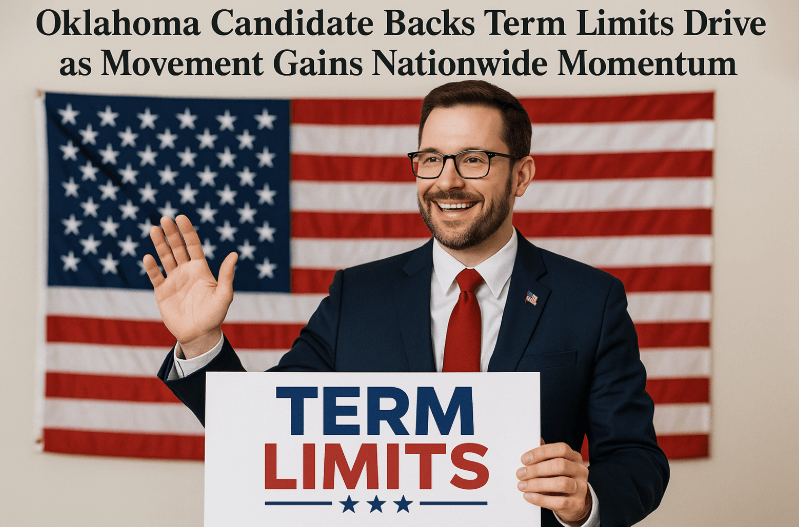
Support for congressional term limits continues to build momentum in the United States, as Oklahoma House District 35 candidate Mike Waters becomes the latest political hopeful to sign the pledge backed by advocacy group U.S. Term Limits (USTL).
USTL, a non-partisan organisation campaigning for a constitutional amendment to impose limits on members of Congress, has been gathering endorsements from state lawmakers and candidates across the country. The group’s long-term goal is to persuade 34 state legislatures to support an amendment proposal convention focused solely on establishing term limits for federal legislators.
Waters’ commitment places him among a growing cohort of state-level politicians aligning with the movement. Fellow candidates in the same Oklahoma district, Travis Dillon and Kevin Wright, have also added their names to the USTL pledge. The special primary election for Oklahoma House District 35 is scheduled for 9 December 2025.
The Term Limits Pledge and Its Purpose
The U.S. Term Limits pledge is distributed to state legislative candidates and officeholders who agree to back a resolution applying for an Article V convention of the U.S. Constitution. The document reads:
“I pledge that, as a member of the state legislature, I will cosponsor, vote for, and defend the resolution applying for an Article V convention for the sole purpose of enacting term limits on Congress.”
The organisation argues that meaningful reform in Washington is unlikely to come from within Congress itself. Instead, its approach focuses on leveraging the constitutional authority of the states to initiate change through a convention process.
Historical and Legal Background
The movement’s legal foundation rests on the 1995 U.S. Supreme Court decision in Thornton v. U.S. Term Limits. In that case, the Court ruled that only a constitutional amendment could impose term limits on members of Congress, effectively preventing individual states from unilaterally restricting federal legislators.
Nick Tomboulides, Chief Executive Officer of U.S. Term Limits, said the convention route remains the most viable path to reform.
“The Constitution allows for amendments to be proposed by either 2/3 of Congress or 2/3 of the states. While we’d like for Congress to take the high road and propose term limits on itself, we know they are too self-interested to do that without external pressure,” said Tomboulides. “That is why it is important to get buy-in from state legislators,” he added. “Once proposed, the amendment must be ratified by 38 states.”
Public Opinion and National Support
The concept of congressional term limits continues to enjoy broad bipartisan support among the American public. Tomboulides pointed to this as evidence that voters are eager to see change at the federal level.
“More than 87% of Americans have rejected the career politician model and want to replace it with citizen leadership. The way to achieve that goal is through a congressional term limits amendment. These candidates know this and are willing to work to make sure we reach our goal.”
Polling data from the Pew Research Center reinforces this claim. Its latest nationwide survey found that “An overwhelming majority of adults (87%) favor limiting the number of terms that members of Congress are allowed to serve. This includes a majority 56% who strongly favor this proposal, just 12% are opposed.”
Building a Coalition of States
U.S. Term Limits continues to focus on persuading state legislatures to pass resolutions supporting the Article V convention. If successful, the effort would mark one of the most significant exercises of state constitutional authority in modern U.S. history.
While Oklahoma’s upcoming special election will fill only one state house seat, the growing number of candidates signing the pledge signals the campaign’s increasing visibility. Analysts suggest that each new endorsement adds momentum to a wider movement aimed at reshaping the relationship between state governments and federal institutions.
The outcome in District 35 is likely to influence not only local political dynamics but also the broader national debate surrounding congressional accountability and the future of leadership in Washington.