

In order to increase the number and diversity of people who have access to scientific data and thus support the development of common scientific potential for the future, the Pierre Auger Collaboration released 10% of the data recorded by the world’s largest cosmic ray detector located in Malargüe, Mendoza province.
The Pierre Auger Project is an international initiative that seeks to determine the origin and identity of cosmic rays to advance the understanding of our universe.
The CNEA is one of the main participants in this project, in which 400 scientists from almost a hundred institutions in 18 countries take part, who observe cosmic ray showers, making measurements of the cascades of particles that are produced each time a Cosmic ray collides with molecules in the upper atmosphere. This determines the energy, direction of arrival and the nature of the cosmic rays of the highest observable energies.
The data from the Pierre Auger Observatory and the computer platform that supports them have enormous value for the world scientific community, so it is expected that their publication will generate educational and science communication initiatives. The data set released consists of 10% of all events recorded in the Observatory, subjected to the same selection and reconstruction procedures used by the Pierre Auger Collaboration in recent publications.
The analysis of these data made it possible, for example, to demonstrate that the higher-energy particles have an extra-galactic origin, measure their energy spectrum and discover indications of the emission of astroparticles from nearby specific sources, as well as characterize the type of particles they transport. these remarkable energies.
To classify this data, it was divided into four levels of complexity adapted for the open access policy of the Auger Collaboration:
Level 1: Open access scientific publications, with additional numerical data to facilitate their reuse.
Level 2: Periodic publication of cosmic ray data in a simplified format for education and outreach. It started in 2007, when 1% of the data was published, and increased to 10% in 2019.
Level 3: Publication of reconstructed cosmic ray events, selected with the best available knowledge of detector performance and conditions at the time of data collection. Examples of code derived from those used by the Collaboration for published analyzes are also provided.
Level 4: Publication of almost raw data of those events. An event and code browser is also provided to read this data.
For more information and access to data, you can visit the website of the Pierre Auger Collaboration, which also includes data from the two main instruments of the Observatory: the Observatory’s Surface Detector, which covers 3000 km2, and the Fluorescence Detector.
About the Pierre Auger Observatory
To solve the riddle of ultra-high energy cosmic rays, the Pierre Auger Observatory studies the cascades of particles that occur every time a cosmic ray strikes molecules in the upper atmosphere. This determines the energy, direction of arrival and the nature of the sub-atomic particles of the highest observable energies.
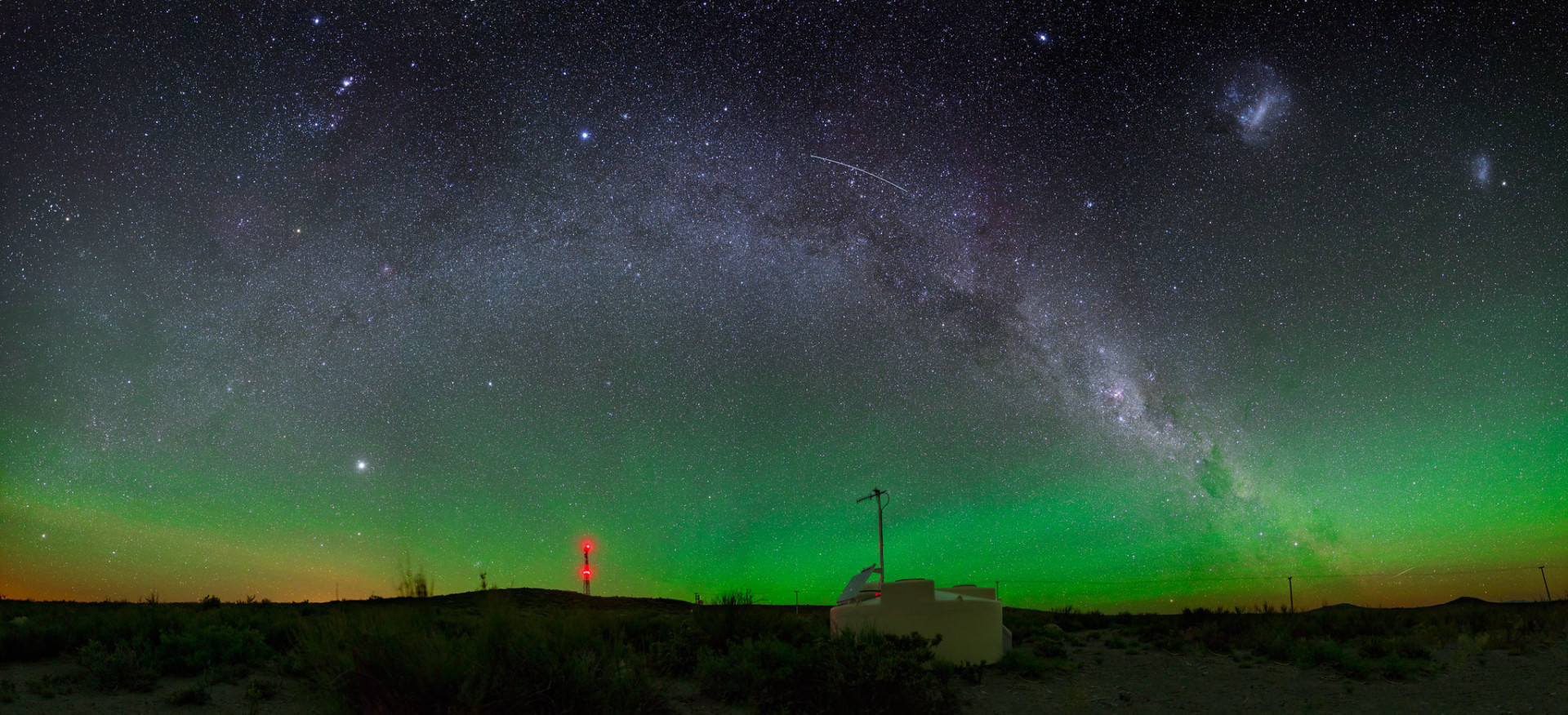
The Observatory is located in the departments of Malargüe and San Rafael, Mendoza province. It manages a network of 1,660 surface detectors, 1.5 km apart, covering a total of 3,000 km2. The network of surface detectors is complemented by a set of 27 highly sensitive telescopes that, on clear moonless nights, scan the atmosphere to observe the faint ultraviolet light produced by cascades of secondary particle showers as they pass through the air.