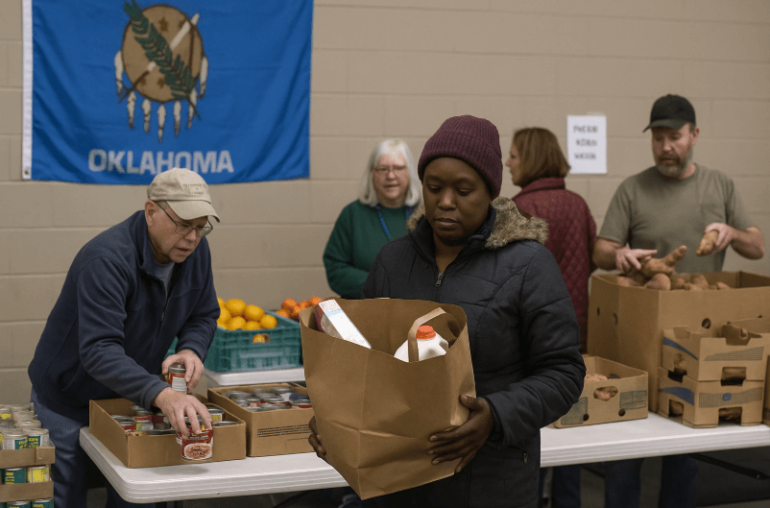
Oklahoma has pledged emergency support to help feed struggling families during the ongoing US government shutdown, which has frozen key federal assistance programmes and raised fresh concerns about the future of healthcare subsidies.
In a move to mitigate the impact of suspended Supplemental Nutrition Assistance Programme (SNAP) benefits, state officials have committed to allocating $1 million per week for seven weeks to Oklahoma’s two major food banks. The measure aims to sustain food distribution while federal funding remains halted.
“I want to start by saying ‘thank you’ to the governor and Oklahoma’s legislative leaders for the commitment to allocate $1 million in state funds per week over the next seven weeks to the two major food banks to assist with food distribution during the suspension of SNAP benefits,” a state representative said. “This will help many Oklahoma families who are struggling.”
However, the official acknowledged that the funding is a fraction of what is needed to cover the shortfall created by the federal shutdown. “The normal monthly allocation from the feds to Oklahoma for SNAP is more than $120 million per month for the 684,000 people in our state who receive benefits. At the level which the state will provide, that only equals to be $5.85 per person per month for every Oklahoman who is on SNAP.”
Limited Relief and Rising Demand
The emergency state funds will assist food banks but will not directly replace the federal benefits. “Additionally, the food banks cannot reach every person on SNAP, and there is no specific requirement this supplement will go only to SNAP recipients due to added demands with so many government employees furloughed,” the statement continued. “With their families in need, there will be increased demand upon our food banks, statewide and local. What they can do is leverage your donation for larger amounts of food, so this is a worthy effort.”
Federal judges have since ordered the Trump administration to release contingency funds to continue partial SNAP payments, using a reserve mechanism designed for funding shortfalls during crises. “This is not a new thing; these funds have been used by every other administration to cover SNAP during government shutdowns,” the official noted. “Leaders said they would not appeal the decisions, meaning SNAP could start being at least partially funded later this week.”
The reprieve may come too late for many households already struggling to cover basic needs. “Even with this, please do what you can to help those in your community because people are likely to face even greater struggles with Thanksgiving and other holidays coming soon,” the statement urged.
Healthcare Subsidies Under Threat
Beyond food security, the shutdown has reignited concerns over the future of health coverage. Enhanced premium subsidies under the Affordable Care Act (ACA) are scheduled to end in 2025, potentially increasing insurance premiums by around 26 per cent from 2026.
“These tax credits, passed several years ago, and extended through 2025 by the Inflation Reduction Act, are set to expire,” the statement explained. “These credits lowered costs for many and made previously ineligible middle-income individuals eligible for insurance at a reduced cost.”
Without congressional action, Americans earning above 400 per cent of the federal poverty level will lose eligibility for the enhanced credits, while lower-income enrollees could face higher out-of-pocket expenses. “Without these tax credits, many will have to end health insurance coverage altogether due to higher costs, leading to more uninsured individuals seeking emergency care and potentially straining hospitals to the point of closure, as we have already seen in Oklahoma,” the spokesperson warned.
Political Deadlock
The issue of healthcare subsidies has become a key point of contention in negotiations to end the shutdown. “Many Democrat officials are refusing to vote reopen the government unless negotiations on these subsides are continued,” the statement observed. “They believe this provides leverage for them to demand the continuation of these subsidies and to lower costs for those on ACA insurance. In contrast, many Republicans do not feel this is a role of government and should be left to the private sector to meet needs, with ACA and SNAP alike.”
As the political impasse continues, American families face escalating challenges: reduced food support, looming healthcare costs, and the loss of income for furloughed federal workers. “Those wanting compromise are being drowned out by the fringe sides of both political ideologies seeking a ‘win’ on these issues,” the representative said. “Meanwhile, American families are facing cuts to food support, increased health insurance costs, and for government employees, a loss of their paycheck until the shutdown ends.”
The statement concluded with a call for civic engagement: “Please reach out to your elected leaders and share your own story about how this is impacting you, as these officials depend upon your vote to continue in office and receive their own paychecks following next November’s elections.”
Broader Implications
The developing situation underscores the interconnection between federal policy disputes and the immediate welfare of ordinary households, with food banks, hospitals and local communities once again absorbing the shock of Washington’s political gridlock.